The Rise of AI-Powered Family Entertainment
The family entertainment center (FEC) industry is at a crossroads. While the $25 billion market continues to grow, the fundamental model hasn't changed in decades: build attractions, sell tickets, hope families come back.
But families today are different. Children raised on AI assistants, interactive apps, and personalized content expect more than bouncy castles and ball pits. Parents want their kids to learn while they play. And both want experiences that feel fresh every single time.
The AI Moment
ChatGPT reached 100 million users faster than any product in history. Google searches for “AI for kids” have surged over 300% since 2023. Major tech companies are racing to create AI-powered educational tools. The message is clear: AI isn't just a trend — it's the defining technology of this generation.
Yet in the physical world, there's nothing. No entertainment venue where children can interact with AI hands-on. No place where they can build robots, design games, or create art with AI assistance. The digital world is racing ahead while physical entertainment stays stuck in the past.
What AI Entertainment Looks Like
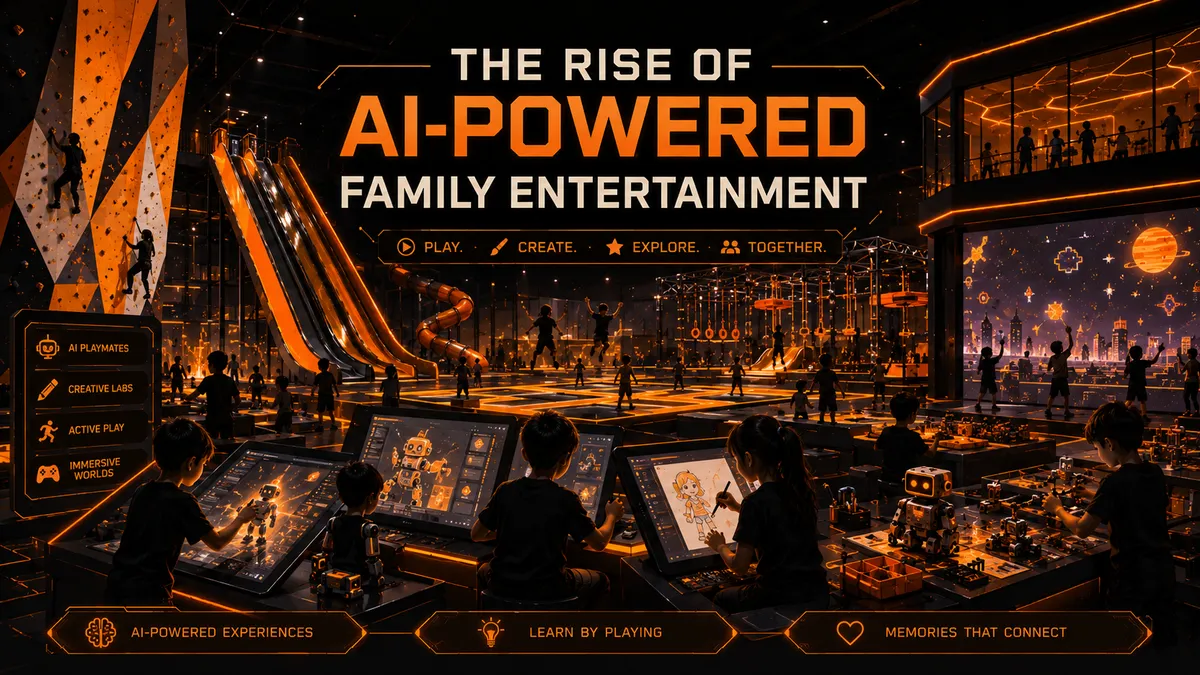
Imagine a 20,000 SF indoor park where every zone is powered by AI:
- Train Your AI Zone: Children teach AI systems to recognize patterns, play games, and make decisions. They learn how machine learning works — by actually doing it.
- Game Dev Studio: Kids design their own video games with AI assistance, then play them on big screens with friends.
- Robotics Lab: Build and program robots that respond to voice commands and learn from interaction.
- AI Quest: Mission-based adventures where AI companions guide children through challenges that adapt in real-time.
- Makerspace: 3D print creations, make trading cards, design posters — and take everything home.
This isn't science fiction. The technology exists today. What's been missing is a team with the entertainment industry experience to package it into a scalable, profitable, family-friendly format.
The Business Opportunity
The economics are compelling. Traditional FECs generate $30–50 per visit. An AI-powered park can achieve $70–90 per visit through premium pricing, memberships, birthday parties, workshops, and merchandise.
More importantly, the repeat visit problem — the biggest challenge in family entertainment — is solved by design. When every visit offers new AI challenges, new things to create, and a progression system that rewards return visits, families come back 4–6 times per year instead of the industry average of 2–3.
What's Next
The first AI Experience Parks are expected to open in 2026–2027 in major US metros, with franchise expansion to follow. The category is wide open. The technology is ready. The demand is overwhelming. The only question is: who will build it first?