FEC Gap Taxonomy
After researching a wide range of family entertainment center (FEC) concepts, interviewing parents, reviewing relevant literature and data, and communicating with participants in our own projects, activities, and events, I outlined the following taxonomy of recurring weaknesses in traditional, equipment-led family entertainment centers, indoor playgrounds, trampoline parks, arcades, activity parks, and similar venues.
I intentionally refrain from offering recommendations at this stage. The purpose is to establish a robust and relatively neutral framework for discussing the industry’s limitations before evaluating potential solutions. Not every issue applies equally to every venue, and some innovative operators have already addressed individual gaps; however, the taxonomy captures the structural challenges that remain widespread across the traditional FEC model.
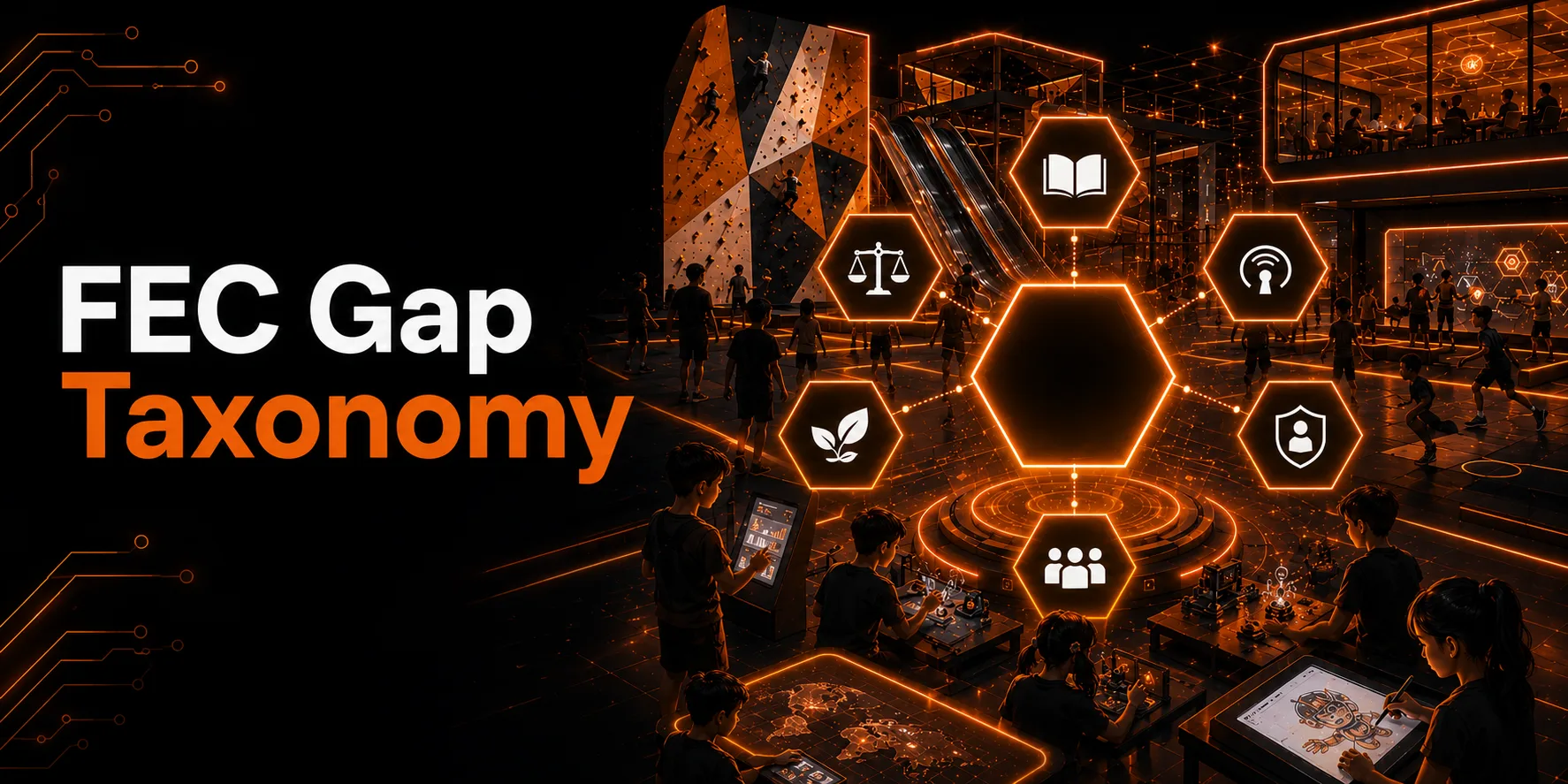
Broadly, these gaps relate to novelty and repeat visitation, developmental value, personalization, the parent and whole-family experience, programming and community engagement, physical-environment limitations, technology and data, service delivery, business-model constraints, emotional engagement, inclusion, and well-being. This taxonomy is intended as a starting point for discussion and refinement, and I certainly welcome additional categories, exclusions, and alternative interpretations.
Novelty, Content, and Repeat Visitation
- Novelty Decay. The excitement generated by a new attraction usually decreases after several visits. Once children understand how the equipment works, the experience becomes predictable and less emotionally rewarding.
- Attraction Fatigue. Repeated use of the same trampolines, slides, climbing structures, arcade machines, or obstacle courses can lead to boredom. Physical equipment alone rarely provides enough variation to sustain long-term engagement.
- Experience Repetition. Each visit often follows almost the same pattern, with limited changes in activities, challenges, or outcomes. Families may feel that they are paying to repeat an experience they have already completed.
- Static Infrastructure Dependence. Traditional parks depend heavily on permanent physical installations. Changing the customer experience therefore requires expensive construction, equipment replacement, or major renovation.
- Content Refresh Deficit. Many parks do not have a structured system for regularly introducing new missions, stories, competitions, or creative content. Novelty is treated as a renovation project rather than as a continuous operational process.
- Replayability Deficit. Activities are commonly designed for immediate use rather than repeated participation. They lack alternative pathways, changing difficulty levels, unpredictable outcomes, or new objectives.
- Discovery Deficit. Children can usually see and understand most of the park during their first visit. There are few hidden elements, evolving environments, secrets, unlockable experiences, or reasons for continued exploration.
- Seasonal Programming Gap. Seasonal decorations may change, but the underlying experience often remains the same. Holidays and school breaks are underused as opportunities for new narratives, challenges, events, and limited-time experiences.
- Trend Adaptation Gap. Traditional parks can be slow to respond to changes in children’s interests, technology, media, games, and social behavior. By the time a new attraction is purchased and installed, the trend may already be declining.
- Single-Visit Design Bias. Many parks are designed to impress first-time visitors rather than retain frequent users. Their business models assume occasional visits, birthday parties, or bad-weather demand instead of weekly participation.
Child Development and Meaningful Value
- Developmental Value Gap. Many attractions provide fun but offer limited visible intellectual, creative, emotional, or social development. Parents may struggle to justify frequent visits when the experience appears to provide entertainment only.
- Educational Integration Gap. Learning activities, when available, are often placed in separate workshops or classrooms. Education is rarely embedded naturally into the core entertainment journey.
- Learning Outcome Invisibility. Even when an activity develops useful abilities, the park may not identify or communicate those benefits. Parents therefore cannot clearly see what their children learned or practiced.
- Creativity Deficit. Children are frequently asked to use equipment according to predetermined rules rather than invent something new. Opportunities to design, write, build, perform, film, compose, or experiment are limited.
- Problem-Solving Deficit. Many attractions reward speed, strength, or repetition but provide little strategic or analytical challenge. Children rarely need to investigate, make decisions, test ideas, or solve complex problems.
- Child Agency Deficit. The park usually determines what children do and how they do it. Children have limited ability to choose their own paths, influence the environment, create rules, or shape the outcome.
- Collaboration Deficit. Activities are often individual, parallel, or competitive rather than genuinely collaborative. Children may play near one another without needing to communicate, negotiate, or work as a team.
- Communication-Skills Gap. Traditional attractions provide few structured opportunities for public speaking, storytelling, interviewing, presenting, or explaining ideas. Verbal and interpersonal development is rarely treated as part of the experience.
- Real-World Relevance Gap. Activities are often disconnected from real occupations, technologies, community problems, or practical life skills. Children may enjoy the experience without understanding how it relates to the world outside the park.
- Entrepreneurial Experience Gap. Few parks allow children to create products, develop business ideas, manage resources, market projects, or interact with simulated customers. Business thinking and financial literacy remain largely unexplored.
- Digital-Creation Gap. Technology is commonly used for entertainment consumption rather than production. Children play games and watch screens but rarely create games, animations, music, digital art, stories, or applications.
- Tangible Outcome Gap. Children frequently leave with no meaningful evidence of what they accomplished. Certificates, projects, books, videos, designs, portfolios, and personalized creations remain underdeveloped.
Personalization, Progression, and Age Relevance
- Personalization Deficit. Every child is usually offered the same experience regardless of interests, skills, personality, or previous visits. The park does not adapt its recommendations or challenges to the individual visitor.
- Persistent Identity Gap. The park rarely remembers the child from one visit to the next. There is no persistent avatar, profile, project history, skill record, or evolving personal journey.
- Progression Gap. Most parks do not provide a clear sequence of levels, missions, or achievements. Children can repeat activities, but they do not feel that they are advancing toward a larger objective.
- Mastery Gap. Children receive few opportunities to improve a skill over time and demonstrate increasing competence. Repetition occurs without coaching, feedback, recognition, or meaningful advancement.
- Adaptive Difficulty Gap. Activities generally have one fixed level or a limited range of difficulty. They may be too easy for experienced children and too frustrating for beginners.
- Interest-Based Journey Gap. A child interested in music, robotics, sports, storytelling, business, or design receives largely the same general experience as everyone else. Parks rarely build specialized pathways around individual interests.
- Age-Segmentation Rigidity. Experiences are commonly divided into broad age categories based mainly on size and safety. Cognitive ability, emotional maturity, interests, and prior experience receive less consideration.
- Sibling Compatibility Gap. Families with children of different ages may struggle to find activities that engage everyone at the same time. Parents are often forced to divide their attention between separate zones.
- Teen Relevance Gap. Traditional playgrounds can feel childish to older children, while arcades alone may not provide enough depth. Many parks lose customers once children reach the preteen or teenage years.
- Preschool Depth Gap. Preschool zones often consist mainly of simplified physical play. Opportunities for language development, sensory exploration, imagination, family interaction, and early problem-solving may be limited.
- Talent Recognition Gap. Parks rarely help identify a child’s strengths, preferences, or emerging abilities. Potential interests in art, engineering, leadership, performance, or entrepreneurship remain unnoticed.
- Achievement Portability Gap. Accomplishments usually have meaning only inside the venue, if they are recorded at all. Children cannot easily continue their projects, display their achievements, or use their progress elsewhere.
Parent and Whole-Family Experience
- Parent–Child Expectation Gap. Children primarily seek excitement, while parents consider development, safety, quality, and value. Traditional parks often satisfy one side of this equation more effectively than the other.
- Parent Experience Deficit. The child is treated as the main customer, while the parent is treated primarily as a supervisor or payer. Comfort, productivity, entertainment, food quality, and social opportunities for adults receive less attention.
- Passive Waiting Model. Parents often spend long periods sitting near play areas without meaningful activities. This waiting time creates little additional value for either the family or the operator.
- Parent–Child Co-Creation Gap. Most activities are designed either for children alone or for parents to observe. Shared projects in which parents and children create, solve, build, or learn together remain uncommon.
- Family Unity Gap. Different family members may use separate areas and have separate experiences. The venue provides physical proximity but not necessarily meaningful shared memories or interaction.
- Progress Communication Gap. Parents receive little information about what their child did, enjoyed, learned, or achieved. There are few post-visit summaries, project portfolios, skill reports, or personalized recommendations.
- Developmental Transparency Gap. Parks rarely explain the developmental purpose behind specific activities. Parents may see noise, screens, and physical movement without understanding the intended benefits.
- Value Perception Gap. Admission prices can appear high when the experience consists mainly of access to equipment. The absence of personalized content, meaningful outcomes, or visible development weakens perceived value.
- Family Convenience Gap. Registration, waivers, socks, food orders, lockers, party arrangements, and activity reservations may require separate processes. Operational friction reduces satisfaction before the experience even begins.
- Parent Productivity Gap. Many parents want to work, read, meet someone, or complete tasks while their children participate. Reliable seating, power outlets, Wi-Fi, quieter areas, and work-friendly environments are often insufficient.
- Parent Community Gap. Parks bring local families together but rarely facilitate meaningful connections among parents. Networking, community groups, educational talks, and parent events remain underdeveloped.
- Healthy Food and Beverage Gap. Food offerings are often limited to pizza, fried products, snacks, and sugary drinks. This can conflict with the developmental, health-focused, and premium positioning that parents increasingly expect.
Social, Community, and Programming Gaps
- Social Connection Deficit. Children may be surrounded by other children without developing meaningful relationships. The venue provides shared space but not necessarily structured interaction or friendship-building.
- Belonging Deficit. Visitors are treated as customers rather than as members of a continuing community. There are few teams, clubs, houses, groups, or identities that create a sense of belonging.
- Recurring Programming Deficit. Traditional parks often rely on open play and birthday parties rather than on a calendar of changing programs. Clubs, workshops, tournaments, performances, and project cycles are limited.
- Event Ecosystem Gap. Events may be occasional promotional activities rather than a central part of the operating model. The park lacks a continuous rhythm of competitions, fairs, festivals, exhibitions, and themed days.
- Community Integration Gap. Many parks operate as isolated commercial venues. Connections with local schools, libraries, nonprofits, sports organizations, government agencies, and community groups remain weak.
- School Partnership Gap. Field trips may exist, but deeper educational partnerships are uncommon. Parks rarely align activities with school subjects, student projects, teacher needs, or academic calendars.
- Local Educator Integration Gap. Tutors, coaches, artists, performers, scientists, and local experts often lack a structured way to offer programs inside the venue. The park misses an opportunity to become a marketplace for children’s enrichment.
- Mentorship Gap. Children rarely interact with professionals or older students who can guide their interests. Mentoring, project coaching, and expert feedback are usually absent.
- Exhibition Gap. Children create very little work that can be presented to others. Galleries, showcases, screenings, demonstrations, performances, and project fairs are underused.
- Civic Engagement Gap. Parks rarely involve children in local environmental, social, or community challenges. Activities remain recreational rather than helping children understand and improve their communities.
- Inclusive Social Design Gap. Unstructured group environments can disadvantage shy children, newcomers, children with disabilities, or those who struggle socially. Few parks actively design facilitated pathways into group participation.
- Intergenerational Engagement Gap. Most experiences target parents and children but exclude grandparents and other family members. Opportunities for several generations to participate meaningfully together remain limited.
Physical Environment, Accessibility, and Comfort
- Equipment-Centered Design. The physical layout is often organized around maximizing the number of attractions rather than creating a coherent customer journey. Equipment placement takes priority over storytelling, comfort, education, and social interaction.
- Fragmented Zoning. Play zones can feel like separate collections of unrelated attractions. Transitions between areas lack narrative, purpose, or continuity.
- Spatial Rigidity. Permanent structures make it difficult to reconfigure the park for new programs, age groups, events, or changing demand.
- Vertical-Space Underutilization. High ceilings, walls, columns, and overhead areas are often treated only as architectural features. They could support climbing, projection, storytelling, displays, challenges, or visual orientation.
- Transition-Space Underutilization. Hallways, waiting zones, queue areas, and entrances often provide little value. These spaces could support mini-games, exhibitions, storytelling, previews, or educational content.
- Wayfinding Deficit. Children and parents may have difficulty understanding where to go, what to do next, or which activities are appropriate.
- Queue Friction. Waiting is commonly treated as an unavoidable inconvenience. Queues rarely contain meaningful activities, interactive content, or reservation systems.
- Capacity Imbalance. Some attractions develop long lines while others remain underused. Without active flow management, park capacity is not distributed efficiently.
- Sensory Overload. Loud music, machines, shouting, bright lighting, screens, and crowded layouts can create excessive stimulation.
- Calm-Space Deficit. Many parks do not provide quiet rooms, recovery zones, sensory breaks, or private family spaces.
- Supervision Visibility Gap. Parents may have difficulty seeing children across large structures or separated zones.
- Universal Accessibility Gap. Physical access may satisfy minimum legal requirements without producing an equivalent experience for children with mobility, sensory, cognitive, visual, or hearing differences.
- Seating and Comfort Deficit. Adult seating is frequently limited, uncomfortable, or poorly located.
- Arrival and Departure Friction. Parking, check-in, waivers, shoe changes, wristbands, lockers, and child collection can create congestion.
Technology, Data, and Digital Continuity
- Passive Screen Dependence. Digital technology is often limited to arcade games, video displays, and passive entertainment.
- Technology Gimmickry. Some parks install VR, projection, or interactive screens primarily for visual impact without depth or repeatability.
- Physical–Digital Disconnect. Digital activities and physical attractions frequently operate as separate products.
- System Fragmentation. Ticketing, waivers, POS, party booking, arcade credits, loyalty programs, and activity platforms may not communicate with one another.
- Child Data Underutilization. Operators may know how much a family spent but not what the child enjoyed, created, completed, or learned.
- Progress-Tracking Deficit. There is usually no integrated system for recording activities, levels, creations, skills, or achievements.
- Recommendation Deficit. Parks rarely suggest what a child should try next based on interests, age, abilities, or previous behavior.
- User-Generated Content Gap. Children have limited opportunities to create content that becomes part of the park.
- At-Home Continuity Gap. The relationship with the child generally ends when the family leaves the building.
- Technology Obsolescence Risk. Specialized hardware can become outdated quickly and may be expensive to maintain.
- Privacy and Consent Underdevelopment. Personalized systems require careful handling of children’s information.
- Automation Deficit. Manual processes remain common in check-in, party management, activity scheduling, and reporting.
Operations, Staffing, and Service Delivery
- Staff-as-Monitors Model. Employees are often trained primarily to supervise safety, enforce rules, and clean equipment rather than to coach, facilitate, or mentor.
- Staff Capability Gap. A modern experience may require skills in education, hospitality, technology, performance, child development, and event management.
- Service Inconsistency. The quality of the visit can depend heavily on which employees are working.
- Facilitation Deficit. Many attractions are expected to entertain children without active human guidance.
- Labor-Intensity Constraint. Rising labor costs can pressure service quality and profitability.
- Maintenance Downtime. Physical attractions require inspections, repairs, replacement parts, and cleaning.
- Cleanliness Perception Gap. Families judge parks strongly by restrooms, food areas, socks, surfaces, smells, and visible cleaning practices.
- Safety–Freedom Imbalance. Strict safety rules can reduce spontaneity and exploration, while insufficient controls increase risk.
- Incident-Response Gap. Staff may be prepared for physical injuries but less prepared for emotional distress, sensory overload, bullying, or separation anxiety.
- Demand Forecasting Gap. Attendance varies significantly by weekends, weather, holidays, and school schedules.
- Experience Quality Measurement Gap. Traditional metrics focus on attendance, revenue, party bookings, and online reviews rather than engagement, learning, and child progress.
- Continuous Improvement Gap. Customer feedback may lead to isolated fixes rather than systematic experience development.
Business Model and Revenue Limitations
- Birthday-Party Dependence. Many FECs rely heavily on birthday parties for profitability.
- Weekend Revenue Concentration. Demand is commonly concentrated on weekends, holidays, and school breaks.
- Weekday Utilization Gap. Traditional parks have limited offerings for homeschoolers, schools, parents with preschoolers, or after-school programs.
- Membership Differentiation Gap. Memberships often provide unlimited or discounted access to the same unchanged attractions.
- Recurring-Revenue Weakness. Without clubs, courses, memberships, projects, or changing missions, predictable monthly revenue remains difficult to build.
- High Capital-Expenditure Dependence. Physical novelty requires expensive equipment purchases and construction.
- Low Content Scalability. A successful physical attraction cannot easily be duplicated or updated without additional equipment and space.
- Pricing Rigidity. Most venues rely on admission, hourly passes, or party packages.
- Ancillary-Revenue Underdevelopment. Retail, food, educational products, digital content, subscriptions, sponsorships, camps, and branded creations are often treated as secondary.
- Space-Yield Imbalance. Some areas generate substantial revenue while others occupy expensive space with limited utilization.
- Mall Integration Gap. Parks in shopping centers often function as isolated tenants rather than systematically sharing traffic.
- Local Provider Marketplace Gap. The venue rarely monetizes its ability to connect families with tutors, coaches, instructors, and local businesses.
Brand, Storytelling, and Emotional Engagement
- Storytelling Deficit. Many parks are collections of attractions without a compelling narrative.
- Purpose Deficit. Activities may be exciting but lack a larger mission or meaningful objective.
- Character Deficit. Traditional parks may use mascots decoratively without integrating them into activities.
- World-Building Gap. The venue does not function as a coherent world with its own rules, places, history, conflicts, and discoveries.
- Emotional Arc Deficit. Strong experiences create anticipation, challenge, tension, achievement, and celebration. Traditional parks often provide activity without a carefully designed emotional journey.
- Cross-Visit Narrative Gap. Stories usually begin and end within one visit.
- Collectible Ecosystem Gap. Prizes are commonly generic arcade merchandise rather than meaningful parts of the experience.
- Brand Differentiation Gap. Many parks offer similar equipment, party packages, and visual styles.
- Intellectual-Property Underdevelopment. Traditional operators often lack original characters, stories, media, games, and educational content.
- Post-Visit Engagement Gap. Communication after the visit usually consists of promotions and birthday offers.
Inclusion, Well-Being, and Social Responsibility
- Neurodiversity Inclusion Gap. Many environments are not designed around different sensory, communication, and attention needs.
- Emotional Well-Being Gap. Parks focus on excitement but pay less attention to confidence, frustration, anxiety, cooperation, or emotional regulation.
- Bullying and Conflict-Management Gap. Competitive and crowded environments can create disputes, exclusion, and aggressive behavior.
- Physical–Cognitive Balance Gap. Some venues provide intense physical activity with little intellectual engagement, while others rely heavily on screens.
- Healthy-Lifestyle Integration Gap. Nutrition, hydration, sleep awareness, posture, emotional health, and long-term wellness are rarely integrated into the concept.
- Economic Accessibility Gap. Admission, food, socks, arcade credits, and party costs can make regular participation unaffordable for many families.
- Cultural Relevance Gap. Content may not reflect the backgrounds, traditions, languages, and experiences of the local community.
- Language Accessibility Gap. Instructions and facilitation may depend heavily on one language or on dense written rules.
- Environmental Responsibility Gap. Large facilities can consume significant energy, materials, food packaging, and disposable party supplies.
- Community Impact Measurement Gap. Operators rarely measure how the park contributes to child development, family well-being, local employment, education, or community connection.
Conclusion
Most of the issues identified above can be traced to six underlying structural limitations:
- Equipment dependence. Customer value is created primarily through access to physical attractions, making the experience expensive to update and difficult to personalize.
- Experience stagnation. The environment and its activities change too slowly to sustain frequent visitation and long-term engagement.
- Developmental underintegration. Entertainment, learning, creativity, social interaction, and physical activity remain separate rather than forming one coherent experience.
- Absence of personalization. The park does not meaningfully know, remember, or adapt to the individual child across multiple visits.
- Transactional orientation. The relationship with the family largely ends when the visit ends, limiting continuity, community, progression, and recurring engagement.
- Platform underdevelopment. The park operates primarily as a physical venue rather than as an ecosystem connecting families, content, educators, technology, events, local providers, and community partners.
The next stage of FEC development may therefore lie not simply in adding newer attractions, but in overcoming these structural limitations.
*By Maksim Godovykh*